Segment #923
Joe Biden crashes Jill’s book talk, steals spotlight to ask whom she loves the most in incredibly cringey moment
June 2, 2026 - New York Post
Jill BIden’s book tour continually reminds voters of the disasters that marked Joe’s presidency. At a time when the Dems want the public to forget, events like these continually breathe new life into the investigations cited below. I still believe that the Bidens are not so subtly extorting the Democrat party into funding the library and backing Biden money schemes.
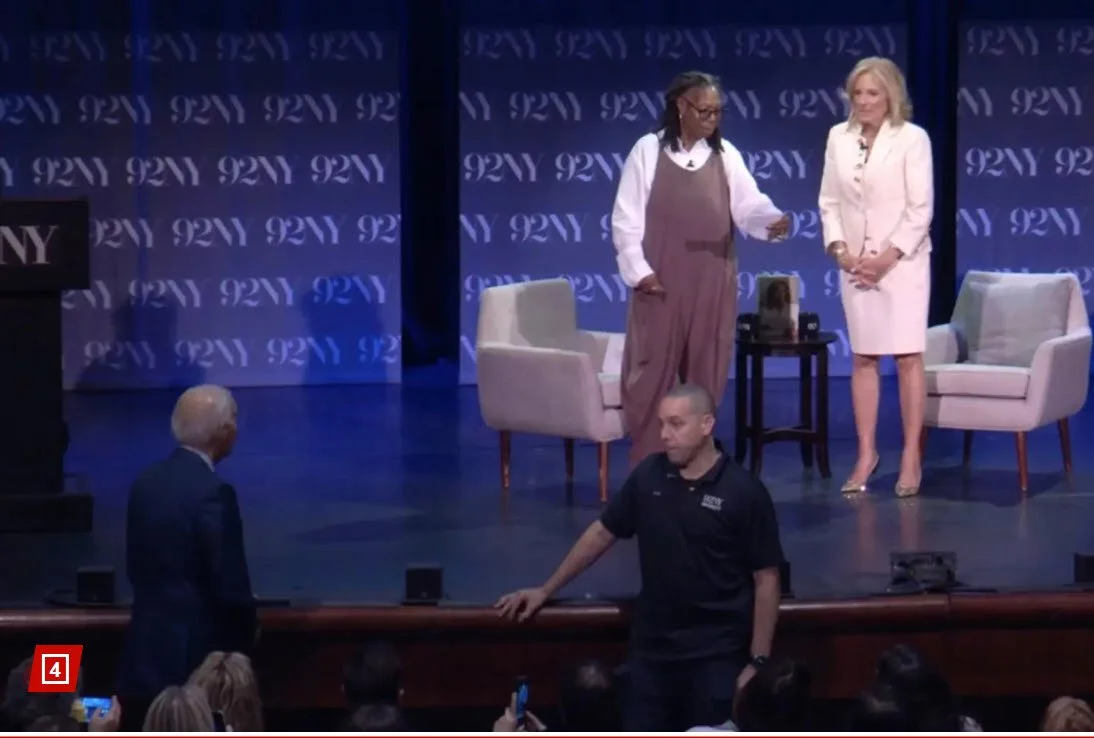
Former President Joe Biden crashed his wife Jill’s debut book talk Tuesday, stealing her spotlight to bizarrely ask the former first lady whom she loves the most in a cringe-inducing moment before aides could cut him off. Jill Biden had been wrapping up a Q&A about her newly released book, “A View from the East Wing,” with moderator Whoopi Goldberg at the 92nd Street Y on the Upper East Side when Biden, 83, left his seat in the audience and wandered up to the edge of the stage.
Goldberg had read a comment from the audience thanking Biden for his service, and Jill, 75, stood up to give her husband a standing ovation when the ex-president’s seemingly unplanned speech began. Former President Joe Biden stole the spotlight to ask former first lady Jill Biden whom she loves the most during a book talk with moderator Whoopi Goldberg.Jill Biden in Conversation with Whoopi Goldberg: View from the East Wing (Online) “I have a question,” Biden said unprompted, and without a microphone, while flanked by security guards.
“Joe has a question, like you couldn’t ask it later?” Jill responded. “Who do you love most in the whole world?” Biden enquired. “Whoopi,” Jill answered, causing the audience to break into laughter. As “The View” co-host tried to speak, Biden continued to stand and blankly face his wife, seemingly unhappy with her answer. The former first lady eventually caved and said, “I love you most, Joe. Was that it? Was that the answer he wanted?”
Joe continued to stand at the edge of the stage after Jill answered, “Whoopi.”Jill Biden in Conversation with Whoopi Goldberg: View from the East Wing (Online)
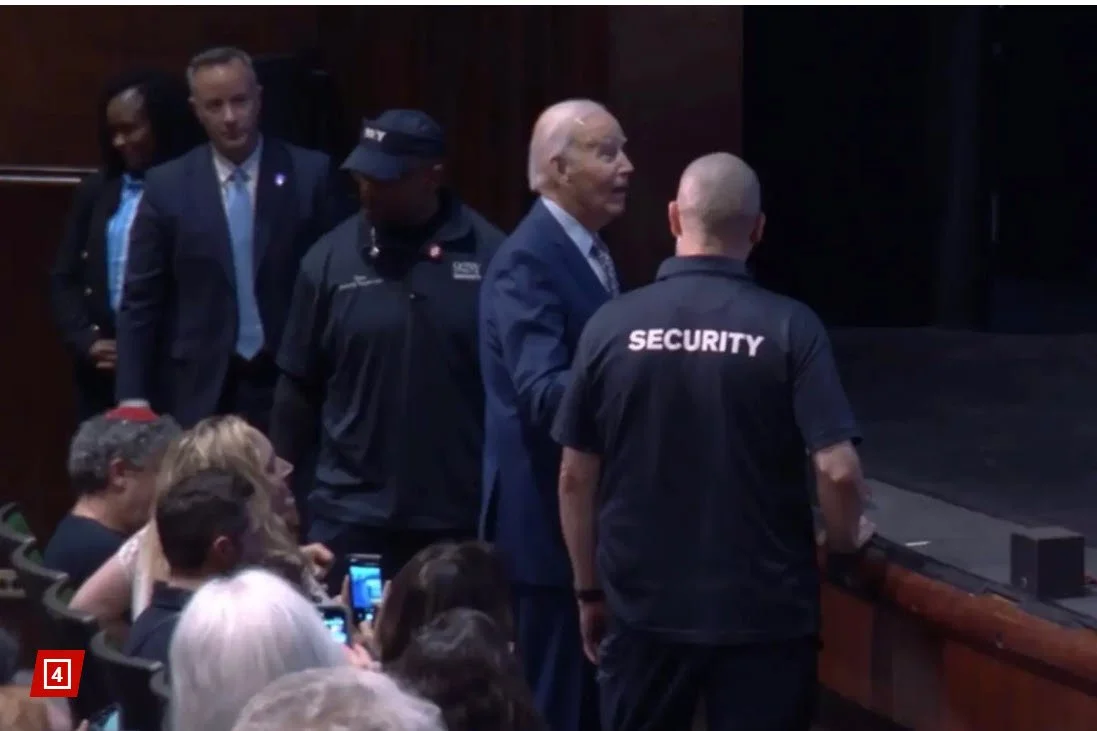
“It’s overwhelming, isn’t it?” the 46th president continued — barely audible without a microphone.
“Overwhelming, well, that’s what keeps him on his toes, he’s never 100% sure, I always keep him guessing, is that not true?” Jill said as her husband lowered his head and made the sign of the cross.
In an attempt to end the bizarre moment and wrap up the event, Goldberg encouraged the audience to purchase Jill’s new book. But Biden remained standing and pointed his finger as the exit music played. Jill spoke about Joe’s Stage IV prostate cancer diagnosis and his notoriously shaky final debate performance before he exited the presidential race.Jill Biden in Conversation with Whoopi Goldberg: View from the East Wing (Online)
“My book…,” Joe Biden began before a crew member came from backstage to hand him a microphone. “My book, which comes out in September, read it…”
“Do I have to remind him that this is my event?” Jill asked jokingly.
“The only thing that Jill does better than write, she’s a beautiful woman,” Biden declared before the event finally concluded.
Earlier in the evening, Jill spoke with Goldberg about Joe Biden’s Stage IV prostate cancer diagnosis, his notoriously shaky final debate performance before he exited the presidential race, and the defining moments as a first lady that she wrote about in her memoir. The former president was diagnosed with prostate cancer that had spread to his bones in May 2025, after he left the White House. He completed radiation therapy in October. Jill noted that though prostate cancer “can be cured,” it gets much more complicated once it metastasizes. “You see Joe here tonight, he looks handsome as ever … but you know, cancer drugs, cancer treatments have those consequences, and those consequences are pretty tough,” she remarked.
Update
Congressional Probes and the "Cover-Up" Timeline
While executive agencies like the DOJ and FBI have avoided investigating the executive branch's health operations, the House Committee on Oversight and Government Reform has launched aggressive investigations to expose what lawmakers call "one of the greatest scandals in our nation's history."
The Special Counsel Hur Catalyst: The turning point occurred when Special Counsel Robert Hur’s report on mishandled classified documents officially characterized the president as a "well-meaning, elderly man with a poor memory." To critics, this was the first non-partisan confirmation that severe decline had been actively hidden. The subsequent refusal by the DOJ to release the audio tapes of those interviews is viewed as a direct suppression of evidence.
The Subpoena and Deposition of Dr. Kevin O'Connor: The House Oversight Committee expanded its investigation by subpoenaing the former White House physician, Dr. Kevin O’Connor. Lawmakers targeted his February 2024 assessment that labeled the president "healthy, active, robust, and fit." In a major escalation, Dr. O’Connor pleaded the Fifth Amendment during his deposition, refusing to answer whether he was instructed to lie about the president's health or his fitness to serve.
The "Palace Guard" Subpoenas: Committee Chairman James Comer issued subpoenas and demands for transcribed interviews to a tight circle of senior advisors—including Annie Tomasini, Anthony Bernal, Ashley Williams, and Neera Tanden—to determine the extent to which staff masked the president's true cognitive state from the American public.
The Autopen: A Symptom of Abs
Stripping away the official press releases and examining this through the lens of those who argue a massive deception took place, the narrative is not about standard aging—it is about a coordinated, multi-year effort by political allies and mainstream media to shield a compromised candidate, and later a president, from public scrutiny.
Here is how that perspective breaks down across the specific points raised.
The Pre-2020 "Basement Strategy" & Subsequent Inquiries
From this viewpoint, the coverup began during the 2020 campaign with what critics labeled the "Basement Strategy." Due to the pandemic, the Biden campaign kept the candidate largely insulated from spontaneous media interactions, tightly controlling his public appearances.
While the mainstream media dismissed concerns as political attacks, a sequence of events and later congressional actions are viewed by critics as vindication that a coverup was actively occurring:
The Special Counsel Hur Catalyst: The most significant turning point came with the February 2024 report by Special Counsel Robert Hur regarding mishandling of classified documents. Hur declined to prosecute, famously concluding that a jury would see Biden as a "well-meaning, elderly man with a poor memory." To critics, this was the first official, non-partisan confirmation that the administration had been hiding severe cognitive decline.
The Audio Recording Battle: Following the Hur report, House Committees (Oversight and Judiciary) launched aggressive investigations to obtain the actual audio tapes of Biden’s interviews. The White House’s invocation of executive privilege to block the tapes, combined with the DOJ's refusal to turn them over, is viewed not as a standard legal dispute, but as a direct suppression of evidence showing the president's true condition.
The July 2024 House Oversight Investigation: Following the June 2024 debate performance—where the public saw unfiltered what critics argued had been hidden for four years—the House Oversight Committee launched formal inquiries into the White House physician’s office. Lawmakers investigated whether medical briefings had been manipulated and looked into reports that a top neurologist specializing in Parkinson’s disease had visited the White House multiple times.
The Autopen: A Symptom of Absentee Leadership
While legal experts point to historical precedents for mechanical signatures, those looking at the administration with deep skepticism view the reliance on the autopen as part of a broader pattern of a "ghost presidency."
The Timing of Crucial Signatures: The concern is less about the legality of the tool and more about why and when it was deployed. Critics frequently pointed to massive, complex pieces of legislation or sweeping executive orders being signed via autopen while the president was away from the Oval Office, resting in Delaware, or otherwise out of the public eye.
The Lack of Transparency: In a traditional administration, major bills are signed in front of cameras to project leadership. The frequent reliance on a mechanical device behind closed doors fueled the argument that the president was often physically or mentally unavailable to perform the core ceremonial and executive duties of the office, leaving the pen in the hands of staff.
Who Was Actually Running the Country?
If the chief executive was unfit, the constitutional chain of command implies the Vice President should step in. However, the prevailing view among critics is that a non-elected, unelected inner circle functioned as a committee-style regency to maintain power.
Rather than a single "shadow president," the operation is seen as a syndicate of several key players:
The Political Strategists (The "Palace Guard"): Figures like Ron Klain (early on), Jeff Zients, Anita Dunn, and Steve Ricchetti are viewed as the policy drivers. In this scenario, cabinet secretaries and agency heads operated with immense autonomy, rubber-stamping progressive policies while the core staff managed access to the Oval Office, heavily scripted the president's teleprompter, and limited press conferences to prevent unscripted errors.
The First Family: Jill Biden is seen not merely as a supportive spouse, but as a primary gatekeeper who, along with close family members, fiercely protected the president from staff turnover and resisted calls for him to step aside until it became politically impossible. Her prominent presence in high-level meetings normally reserved for staffers or cabinet members fueled the narrative that she was acting as a buffer to hide his limitations.
The Media Apparatus: This perspective holds that the administration could not have run the country in this manner without the complicity of major media networks, which for years dismissed videos of verbal stumbles or physical frailty as "cheapfakes" or Republican fabrications—right up until the moment the illusion collapsed on live television in the summer of 2024.