
Segment #1015
U.S. Strategy: Use Overwhelming Leverage—But Close the Deal
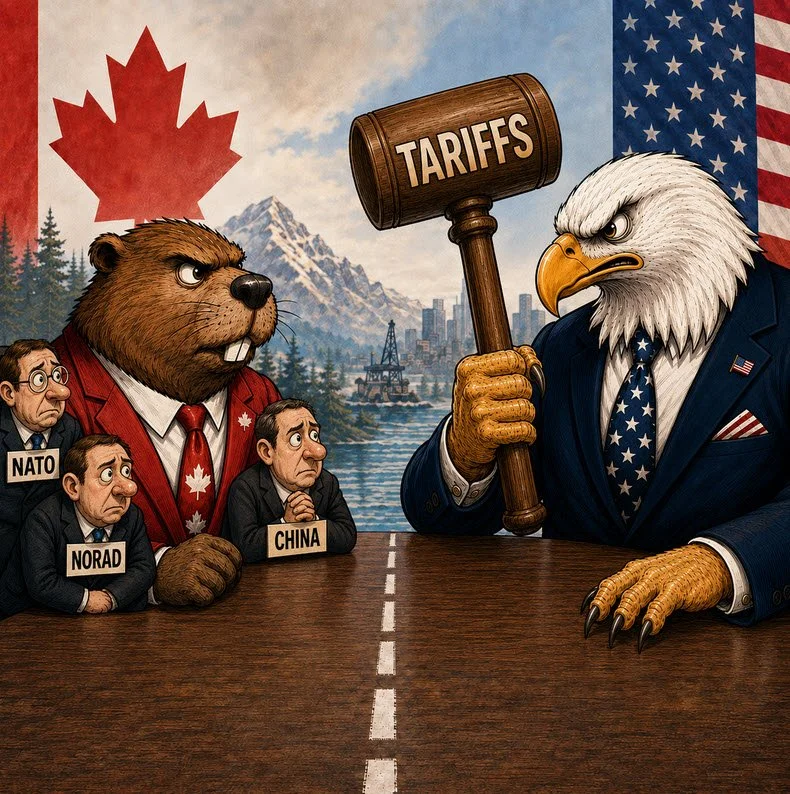
Canada’s retaliation does not change the central reality: Canada needs the U.S. market far more than the United States needs Canada. Roughly three-quarters of Canadian goods exports go south, while the U.S. economy is approximately 13 times larger.
Washington’s strategy is to exploit that imbalance.
The 50% tariffs are intended to force Canada to:
Open its protected dairy, alcohol, and automobile markets.
Reduce barriers affecting U.S. steel, aluminum, lumber, and manufactured goods.
Stop retaliating against American trade measures.
Accept a substantially tougher replacement for the current USMCA.
Move Canadian production and future investment into the United States.
Canada has responded with matching tariffs on C$27.6 billion of U.S. goods and C$7.5 billion in assistance to affected workers and businesses. This will hurt selected American farmers, manufacturers, and exporters, but Canada cannot match America’s economic endurance.
The danger for Washington is not losing the tariff war. It is winning it badly. North American supply chains are deeply integrated. Prolonged tariffs will raise American costs for construction, manufacturing, agriculture, automobiles, and consumer goods. They could also turn a negotiable trade dispute into a Canadian sovereignty issue, hardening resistance.
Recommended U.S. approach
Washington should give Canada a short, firm path to settlement:
Suspend the new tariffs if Canada postpones its September 8 retaliation.
Demand immediate concessions on alcohol, dairy quotas, and automobile restrictions.
Remove U.S. tariffs sector by sector only after Canada complies.
Keep energy, potash, critical minerals, and essential industrial inputs exempt.
Negotiate broader changes through a tougher, enforceable successor to USMCA.
Bottom line: America has the stronger hand and should use it. But tariffs are leverage, not the objective. The U.S. should force measurable Canadian concessions, secure better market access, and end the confrontation before the costs begin outweighing the gains.
The Politics
U.S. Strategy: Bring Canada Back into the American Orbit
This is bigger than tariffs. Washington increasingly views Canada as a country benefiting from privileged access to the United States while pursuing policies that conflict with American economic, political, and security priorities.
The tariffs are the pressure mechanism. The broader objective is strategic realignment.
From the U.S. perspective, Canada has:
Protected dairy, automobiles, alcohol, and other industries from American competition.
Used regulations, subsidies, and quotas that disadvantage U.S. companies.
Restricted energy and resource development while relying on the American market.
Failed to carry a proportionate share of continental defense.
Pursued approaches to China, technology regulation, climate policy, and industrial policy that do not consistently support U.S. priorities.
Expected the benefits of USMCA, NORAD, NATO, and American security without accepting corresponding American conditions.
Washington’s emerging position is blunt: Canada cannot operate economically and politically as an independent counterweight to the United States while continuing to receive uniquely favorable access to the American market.
The actual American objectives
The United States is trying to force Canada to:
Open protected Canadian markets to American products.
Align energy and critical-mineral development with U.S. security needs.
Increase defense spending and strengthen Arctic and border security.
Reduce economic and technological exposure to China.
Harmonize regulations where Canadian rules obstruct U.S. companies.
Accept a revised USMCA built around American industrial and national-security priorities.
Recognize that privileged access to the U.S. market is conditional—not automatic.
Canada’s “dollar-for-dollar” retaliation is therefore strategically limited. It answers the tariff calculation but not the underlying power contest. Canada cannot match America’s market, military, capital, or geopolitical weight. Its C$7.5 billion support package may delay economic pain, but it cannot remove Canadian dependence on the United States.
The risk to Washington
The United States can economically overpower Canada, but excessive public humiliation could create lasting Canadian nationalism, accelerate trade diversification, and turn a manageable policy dispute into permanent political hostility.
Bottom line
Trump is furious that Canada is cozying up to China while resisting his demands on NORAD modernization and NATO defense spending. Yes, and even trading with Iran might be a further provocation for Trump’s ire. From his perspective, Ottawa wants U.S. protection and privileged access to the American market while undermining Washington’s strategy against Beijing—an act of political and strategic betrayal by America’s closest neighbor.
Canada’s Failure
Defense Spending
Canada badly underperformed NATO’s defense-spending benchmark for more than a decade, although it has now reached the former target.
NATO’s benchmark was 2% of GDP.
Canada spent only 1.01% in 2014, 1.33% in 2023, and an estimated 1.47% in 2024.
In 2024 alone, Canada spent about C$44.3 billion—roughly C$16 billion less than 2% would have required.
Using NATO’s annual figures, Canada’s cumulative spending gap from 2014 through 2024 was approximately C$186 billion compared with spending 2% every year.
NATO estimated Canada reached 2.01% in 2025, and Canada subsequently confirmed that it had achieved the 2% benchmark. NATO defense-expenditure report, Government of Canada
One qualification: the 2% figure was a political commitment and benchmark—not a legally enforceable NATO “bill.” Moreover, the 2014 pledge gave allies until 2024 to move toward 2%, so the C$186 billion figure measures cumulative underspending against the benchmark, not a formal debt Canada owes NATO.
The blunt conclusion: Canada arrived at the old 2% target roughly a decade late, after accumulating a defense-investment deficit approaching C$200 billion and allowing significant military capability and readiness problems to develop.
Correct. NATO’s current commitment is 5% of GDP by 2035, adopted at the June 2025 Hague Summit:
3.5% for core military spending.
Up to 1.5% for defense-related infrastructure, cybersecurity, resilience and industrial capacity.
The 2% benchmark originated in 2006 and was reaffirmed at the 2014 Wales Summit, where members promised to move toward it within ten years—by 2024. Canada missed that deadline, spending only about 1.47% in 2024, before reaching approximately 2% afterward.
However, it would be inaccurate to say Canada is currently violating a requirement to spend 5% immediately. The commitment requires a credible annual path toward 5% by 2035, with progress reviewed in 2029. At roughly 2% today, Canada remains approximately three percentage points—or around C$90–C$100 billion annually—below the eventual 5% level, although some Canadian infrastructure and security spending may qualify toward the 1.5% category. NATO’s 2025 Hague Declaration, NATO’s 2014 Wales Declaration
NORAD
Canada’s NORAD failure is best described as decades of underinvestment that left the United States carrying a disproportionate share of continental defense, rather than failure to pay a specific NORAD assessment.
Canada’s principal shortcomings are:
The aging North Warning System cannot adequately detect modern cruise missiles, hypersonic weapons and other low-flying threats.
Replacement Arctic and Polar over-the-horizon radars will not be fully operational until approximately 2031 and 2033.
Canada continues relying on aging CF-18 fighters while its F-35 replacement program is implemented.
Northern airfields, communications, fuel supplies and forward-operating infrastructure remain inadequate for sustained Arctic operations.
Canada reported that only 48.9% of its key aerospace fleets were serviceable in 2023–24, against an 85% target.
Canadian and American forces encountered communications and interoperability problems because Canada lacked the same classified information systems.
Personnel shortages remain severe: Canada estimates that NORAD modernization and its new defense policy could require 14,500 additional personnel.
Canada announced C$38.6 billion over 20 years for NORAD modernization in 2022, but much of the actual capital expenditure has been pushed into the 2030s. The Parliamentary Budget Officer warned that repeated procurement delays and inflation could reduce what that money ultimately buys.
Canada still supplies personnel, fighters, bases and command facilities and continues fulfilling day-to-day NORAD missions. Therefore, it has not abandoned NORAD. The more accurate criticism is that Canada allowed its detection, interception and Arctic-support capabilities to deteriorate while depending increasingly upon American systems and military capacity to defend Canadian territory.
In blunt terms: Canada remained formally committed to NORAD but failed for years to provide the modern equipment, readiness and northern infrastructure that an equal continental-defense partner should provide.Canadian NORAD modernization schedule, Canadian Armed Forces readiness results, Parliamentary Budget Officer report
Trade with Iran
Yes. Canada trades with Iran, but the trade is limited and heavily restricted.
In 2025, Canada exported approximately US$276 million in goods to Iran. Almost the entire amount—about US$271 million—consisted of oilseeds, grains and related agricultural products. Pharmaceuticals and other humanitarian or nonsensitive goods accounted for much of the remainder. UN Comtrade figures
Canada also imports a relatively small volume of Iranian goods, principally foods, agricultural products, carpets and consumer items. Iran is not a major Canadian trading partner.
Canada does not maintain a complete trade embargo. Its sanctions prohibit or restrict:
Weapons and military equipment
Nuclear and ballistic-missile technology
Sensitive dual-use products
Services for specified Iranian vessels
Transactions with designated Iranian officials, the IRGC and sanctioned companies
Financial or technical assistance connected to prohibited activities
Ordinary trade in lawful products—particularly food, medicine and humanitarian goods—can continue provided neither the goods nor the parties are sanctioned. Government of Canada sanctions rules
Therefore, the accurate formulation is: Canada continues several hundred million dollars of largely agricultural trade with Iran while claiming to maintain severe sanctions against Iran’s government, military, nuclear and missile networks. This is substantially different from trading in Iranian oil, weapons or strategic technology.