
Segment #956
Mamdani ERUPTS As Goldman Sachs QUIETLY Shifts Jobs to Texas and Florida
For 157 years, Goldman Sachs was synonymous with New York — a firm founded in 1869 by an immigrant trading commercial paper from his hatband on a Lower Manhattan street corner. In this breakdown, we examine the internal initiative, reportedly nicknamed "Project Voyage," through which Goldman has pressured senior managers, vice presidents, and managing directors to relocate to Dallas or leave the firm, even as an 800,000-square-foot campus rises in North Texas — set to become the bank's second-largest U.S. facility when it opens in 2028. We trace how a quiet regional outpost became a rival power center, and why Mayor Zohran Mamdani responded with public criticism followed by a private meeting with Goldman's CEO at City Hall. The deeper story is fiscal. Goldman's move is part of a wider pattern: JPMorgan has shifted thousands of positions from New York to Texas over the past decade, other major firms are expanding in low-tax states, and New York now ranks dead last in the Tax Foundation's state tax competitiveness rankings — all while Mamdani proposes higher taxes on corporations and the wealthy to close a budget gap of roughly $12 billion. At the center of this video sits a single overlooked statistic about how much of New York's tax revenue depends on one industry, and a budget projection that has already fallen short. This is not a story about billionaire grievances. It is structural math about who funds the city — and what happens when those people begin mapping out new addresses.
Seattle Mayor PANICS As Downtown Turns Into Economic Wasteland | Warren Buffet
Seattle's downtown hasn't just slowed down—it has officially COLLAPSED. Seattle's downtown faces a significant challenge, with a high seattle office vacancy rate pointing to a potential city collapse rather than recovery. This situation raises questions about why cities fail and the broader implications for commercial real estate and the local "property market" in the region. With a catastrophic 35.6% office vacancy rate, America’s former tech capital is locked in a terrifying economic death spiral. Major corporations are PANICKING. Amazon has already shifted 15,000 jobs to Bellevue, Starbucks is funneling millions into Tennessee, and investors are fleeing the city's crushing new tax stack. The most shocking part? While 2.3 million square feet of skyscrapers sit completely dark and historic local businesses are wiped out, Seattle’s Mayor just admitted these taxes are driving companies away—and she’s proposing MORE of them. This isn't a remote work story; it's a brutal macroeconomic exodus. Discover the hidden reality behind the corporate flight, the looming $140M deficit, and why Bellevue is stealing Seattle’s empire overnight. Is this the end of Seattle? Subscribe for the untold data behind the narrative!
Office Space Vacancies in Sanctuary Cities in the U.S.
While "sanctuary city" is a political and legal designation rather than a formal commercial real estate classification, many of the largest metropolitan areas that fit this description (such as New York City, San Francisco, Chicago, Los Angeles, and Seattle) are major urban gateway markets.
The office real estate market has hit a major inflection point. While the national vacancy rate is hovering between 14% and 17.8% (depending on whether the metrics include sublease inventory and building removals), performance varies drastically based on the specific city and the quality of the building.
The landscape across major cities generally classified under sanctuary policies breaks down as follows:
Major Gateway Cities & Vacancy Rates
Metro AreaQ1 2026 Office Vacancy RateMarket Dynamics
New York City (Manhattan)13.1%Leading the national urban recovery. High demand for Class A/Trophy assets has driven vacancy down 340 basis points over the last year
Chicago22% - 24%Facing persistent headwinds in the Central Business District (CBD). While newer, highly-amenitized loop and Fulton Market spaces are leasing, older Class B/C stock remains heavily vacant
Los Angeles26.2%High overall vacancy driven by a slow return-to-office culture in creative/tech spaces, though prime Westside areas are beginning to see a stabilization in leasing activity.
San Francisco23.3% - 28%While still dealing with post-pandemic tech contractions, the market is stabilizing due to a massive surge in AI company leasing and aggressive office-to-residential conversions.
Seattle23.3%Experiencing a tentative floor in vacancy as major tech employers enforce stricter in-office mandates, boosting downtown foot traffic.
Washington, D.C.19.0%The city center sits at 19% vacancy. Government downsizings are being offset by a significant removal of obsolete stock; roughly 3.7 million sq. ft. of office space was pulled for residential conversion early this year.
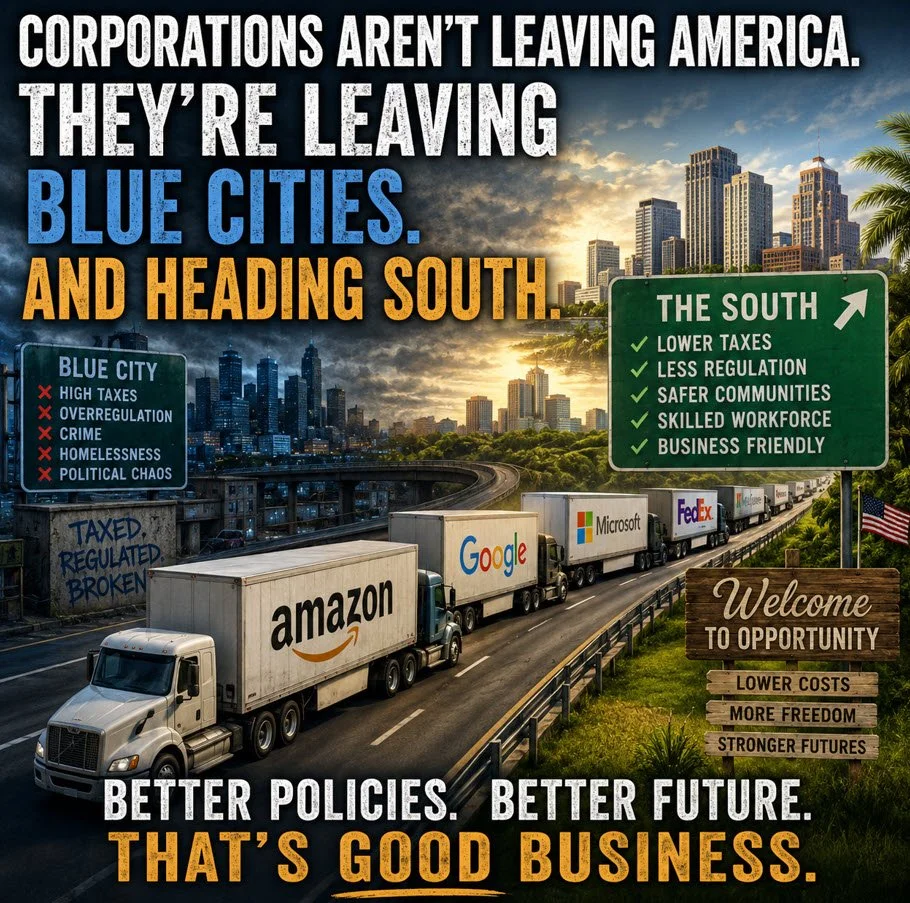
When analyzing corporate and resident relocation data, removing political talking points reveals a clear, quantifiable trend: companies are moving, but the decision is driven by strict financial math and risk management, not ideology.
The data from the IRS, commercial real estate firms (like JLL and CBRE), and corporate filings show that taxes, cost of living/quality of life, and public safety/infrastructure are the primary catalysts behind the corporate migration out of high-cost gateway markets.
The Tax Math (The Bottom Line)
The most concrete, non-political reason companies and high earners move is the optimization of balance sheets.
Corporate & Income Tax Disparities: States like California, New York, and Illinois feature high corporate tax rates and top individual income tax brackets reaching up to 13.3%. Conversely, top destination states like Texas, Florida, and Tennessee have 0% state individual income tax and lower or highly structured corporate tax frameworks.
The Capital Flight Shift: According to IRS Statistics of Income migration data, California lost approximately $11.9 billion in Adjusted Gross Income (AGI), New York lost $9.9 billion, and Illinois lost $6 billion. Florida and Texas gained $20.6 billion and $5.5 billion respectively. When top earners and executives relocate for personal tax reasons, the corporate headquarters or major satellite offices frequently follow (e.g., Citadel, Oracle, and SpaceX).
Quality of Life & The Cost of Living Gap
"Quality of life" in commercial real estate terms translates directly to employee retention and compensation leverage.
The Housing Premium: In gateway cities, a median-priced home or high-end apartment requires premium compensation packages just for employees to maintain a middle-class lifestyle. By moving operations or hiring remote/hybrid hubs in "welcomer cities" (like Nashville, Orlando, or Dallas-Fort Worth), companies can offer highly competitive local salaries that stretch much further due to lower regional housing costs.
Education and Family Retention: For mid-level and senior executives with families, local school performance and neighborhood safety are primary retention metrics. When public school systems in major urban centers struggle or cost-of-living pushes families into extreme commutes, companies face higher turnover. Moving to master-planned corporate suburbs (like Frisco or Plano outside Dallas, or Franklin near Nashville) allows companies to anchor their workforce near top-tier public school districts.
Crime and Urban Risk Management
From a pure business operational perspective, crime isn't discussed as a political talking point—it is evaluated as an operational cost and security risk.
Commercial Asset Degradation: Retailers and customer-facing corporate offices face direct hits to their bottom line from property crime, shrinkage, and graffiti. In cities like Seattle and San Francisco, manufacturers and retail hubs have explicitly cited the "constant battle with the city over graffiti and property crime" as a major factor in non-renewal of commercial leases.
Foot Traffic and Employee Safety: High-profile commercial exits (such as various retail and corporate office footprints in downtown Portland and San Francisco) frequently point to employee safety concerns during commutes. If employees refuse to utilize public transit or walk downtown corridors due to safety perceptions, strict in-office or hybrid mandates fail, rendering expensive downtown office leases useless.
Summary of Major Corporate Moves
CompanyFormer LocationNew Hub / HQ LocationPrimary Stated/Economic Drivers
SpaceX / XCaliforniaTexasRegulatory friction, high state tax environment.
OracleCaliforniaTexas / TennesseeCost of living for workforce, proximity to growing tech talent hubs.
CitadelChicagoMiami, FLPublic safety concerns for employees, zero state income tax.
Starbucks (Corporate Roles)SeattleTennessee (Expanding Hubs)Local regulatory environment, high corporate surcharges/taxes.
Ultimately, corporations "vote with their feet." When the structural cost of doing business (taxes + security + inflated wages to match the cost of living) outweighs the benefits of a city's historical talent pool, the math dictates relocation.
Blue States Proposing Wealth and Exit Taxes
This video breaks down how several high-tax states are exploring new legislative measures to combat the revenue losses caused by this specific corporate and high-earner migration.