
Brown Univ and Providence Face Serious Liability
Segment #706
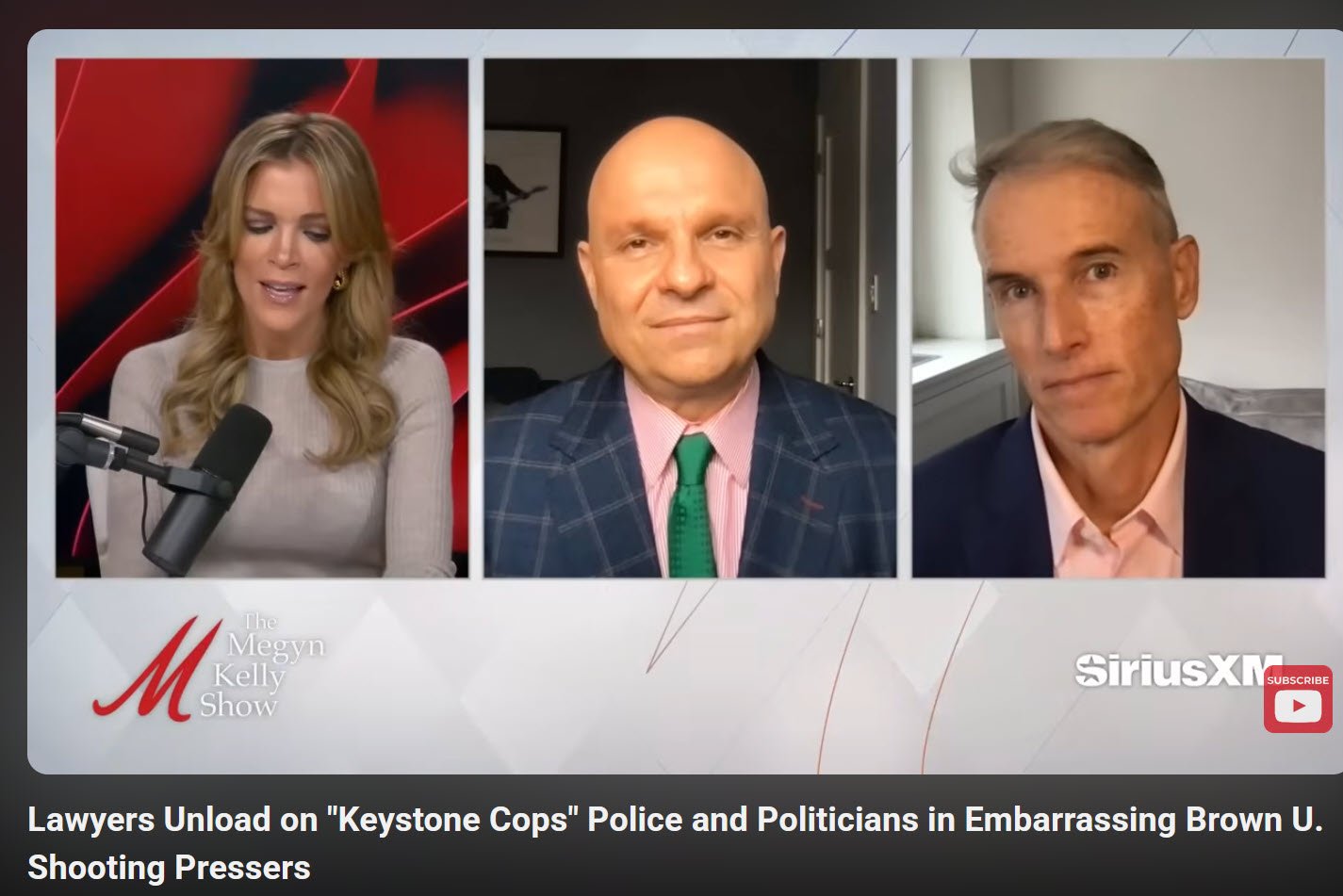
Brown University's Potential Liability in the December 2025 Shooting
As of December 17, 2025, no lawsuits have been filed against Brown University related to the mass shooting at the Barus & Holley building (killing two students and injuring nine). However, the incident has sparked widespread discussion about the university's potential civil liability for negligent security, particularly given the lack of interior surveillance cameras in the targeted older section of the building.
Key Factors Fueling Liability Concerns
Limited Camera Coverage: Brown has over 1,200 cameras campus-wide, primarily in high-traffic exterior areas, entrances, and newer buildings. Officials (including RI AG Peter Neronha and university spokespeople) explain that the shooting occurred in an "older" part of Barus & Holley (on the campus edge), with "fewer, if any" interior cameras in hallways or classrooms. No footage shows the shooter entering or inside the building—only exterior/neighborhood views of a masked suspect fleeing.
Foreseeability and Duty of Care: Universities owe students a duty to provide reasonable security against foreseeable risks, including active shooters (a growing threat in the US). Critics argue the absence of cameras in a study/review session space during finals week constitutes negligence, especially at a wealthy Ivy League institution.
Emerging Allegation: A conservative blog (The Last Refuge) claims Brown received an August 2025 letter from 34 human rights groups (led by "Fight for the Future") pressuring 150 colleges to disable or limit CCTV/facial recognition systems for privacy reasons. If Brown partially complied (e.g., deactivating or not upgrading cameras), this could elevate claims to willful negligence—potentially exposing the university to massive damages by undermining "reasonable care" defenses.
Precedents: Past school shootings (e.g., Virginia Tech, Sandy Hook) led to settlements or verdicts in the tens/hundreds of millions for security lapses. Victims' families often sue for wrongful death/negligence.
Critical Liability issues for Brown Univ and Providence
Technology and Security Camera Issues:
If evidence emerges of deliberate camera deactivation due to activist pressure, liability could become severe ("massive lawsuit exposure" per some commentators). Combined with public frustration (student petitions for better security, criticism from figures like President Trump), Failure to secure the Barus and Holley building with both camera and entry protocols is a major issue for establishing liability.
Brown maintains an expansive network with approximately 1,200 security cameras campus-wide, card access systems for residence halls (with door alarms), emergency blue-light phones, and a multi-channel alert system (texts, calls, emails). The department also uses building security initiatives and hostile intruder training.However, coverage is uneven: The Barus & Holley building (site of the December 13, 2025, shooting) is an older structure on the campus edge with limited or no cameras in key areas, allowing the shooter to enter/exit without clear capture. Alerts were sent within minutes but criticized as delayed/conflicting; the campus siren system (3 sirens) was not activated, as it is intended for outdoor threats rather than indoor active shooters. Many academic buildings remain unlocked during daytime hours, consistent with open-campus policies at several Ivies but now under review.Post-shooting, Brown announced a large-scale systematic security review of the entire campus, including potential enhancements to cameras, access controls, and alerts. Students and nearby residents (e.g., from RISD) have petitioned for improvements, citing gaps that aided the shooter's escape.In summary, Brown's DPS exceeds baseline training/accreditation standards comparable to other elite universities, but technology and procedural gaps—exposed by internal no-confidence votes (2025) and the recent incident—indicate it has not fully met expectations for comprehensive modern campus security. The ongoing review may address these shortcomings.
Vice President for Public Safety and Chief of Police Rodney Chatman and Deputy Chief John Vinson:
Yes, Brown's campus security chief faced votes of no confidence earlier in 2025.In 2025, both unions representing officers in Brown's Department of Public Safety (DPS) issued votes of no confidence in Vice President for Public Safety and Chief of Police Rodney Chatman and Deputy Chief John Vinson:
August 2025: The Brown University Police Sergeants Union (representing 10 sergeants) unanimously voted no confidence on August 27, citing failed leadership, contract violations, a "dictatorial management style," inadequate responses to threats (including bomb and shooting threats), harassment concerns, and policies jeopardizing safety and well-being.
October 2025: The Brown University Security and Patrolperson’s Association (BUSPA, representing ~40 officers, security, and guards) followed with another no-confidence vote (finalized October 17), highlighting low morale, high turnover (highest at the university), prioritization of administrative roles over field officers, a climate of fear and retaliation, equipment failures, and strained community service.
These votes predated the December 13, 2025, mass shooting on campus (which killed two students and injured nine). The pre-existing internal criticisms of DPS leadership— including concerns over threat responses and preparedness—have been resurfaced in media coverage of the shooting, with scrutiny over delayed alerts, lack of sirens, and limited surveillance contributing to questions about security effectiveness.As of December 18, 2025, Chatman remains in his position, speaking publicly on the incident, and no leadership changes have been announced. The university has emphasized commitment to safety and ongoing communication with unions, while pledging a large-scale security review.(Note: An earlier no-confidence vote occurred in 2016 under previous leadership, unrelated to the current chief.)
Chatman Previous Work History: Rodney Chatman's tenure as Chief of Police at the University of Utah (February 2020–July 2021) was marked by controversy, primarily over certification issues and internal reforms.Chatman was hired in February 2020 to lead the department amid scrutiny following the 2018 murder of student Lauren McCluskey, which exposed mishandling by campus police. He initiated reforms, including an independent review that confirmed an officer (Miguel Deras) had inappropriately shared explicit photos of McCluskey. This led to firings and resignations, drawing backlash from some officers and the Utah Fraternal Order of Police.Key events:
Certification dispute: Coming from Ohio (prior roles at University of Dayton and University of Cincinnati), Chatman was given one year to obtain Utah Peace Officer Standards and Training (POST) certification. He obtained it in October 2020 (within the timeframe). However, allegations arose that he improperly carried a badge/gun or performed duties before full certification.
December 2020: Placed on administrative leave pending an investigation by the Utah Attorney General's Office into potential criminal offenses related to certification and guidelines.
June 2021: Salt Lake County District Attorney cleared him of all charges, finding no evidence of misconduct (he had consulted POST and limited actions accordingly; administrative oversight was allowed).
July 2021: Despite clearance, Chatman resigned, alleging retaliation for his reforms. He accepted a higher-title position as Vice President for Campus Safety at Brown University (starting September 2021). Brown acknowledged the cleared allegations in its hiring announcement.
Chatman later sued the University of Utah for discrimination, retaliation, and breach of contract (initially seeking $10M, later $2.5M). A federal judge dismissed the case in September 2023, ruling insufficient evidence.The Utah episode has been resurfaced in recent coverage of Brown's December 2025 shooting, highlighting past questions about Chatman's credentials and leadership under pressure. No criminal findings were ever made against him.
Providence Police Chief Col. Oscar Perez
Providence Police Chief Col. Oscar Perez has faced public scrutiny related to family matters, primarily involving his nephew's criminal activity and a recent personal issue.Nephew's Drug Trafficking Case (2024)Perez's nephew, Jasdrual "Josh" Perez, pleaded guilty in 2024 to running a large-scale fentanyl and cocaine trafficking operation across multiple states. Federal prosecutors described Josh as having "knowledge and technique for avoiding law enforcement" uncommon among dealers. He reportedly boasted about family connections to the Providence Police Department (naming his uncles) and trips to Colombia.
Josh is the son of Perez's brother, Providence Police Sgt. Andres Perez (who headed the department's intelligence and organized crime unit).
A 2024 Rhode Island Monthly investigation detailed how the case caused significant family tension and heartbreak, including a rift involving Oscar Perez and his elderly father.
Federal filings later implicated Sgt. Andres Perez in potentially aiding his son (e.g., allegations of interference), but Chief Oscar Perez has not been accused of any wrongdoing or involvement. He and his brother cooperated with federal investigators.
The case has been resurfaced in some critical online commentary amid the Brown University shooting investigation, often in partisan or sensational sources questioning Perez's leadership.
Recent Personal Family Matter (December 2025)In a December 17, 2025, interview with The Providence Journal, Perez disclosed he was "dealing with a personal family matter" and in transit when the initial report of the Brown University shooting came in on December 13. No further details were provided, and it appears unrelated to prior issues.No public reports indicate divorces, domestic allegations, or other personal scandals directly involving Chief Perez himself. His background as an immigrant from Medellín, Colombia (arriving at age 13), and his rise to become Providence's first Latino police chief are frequently highlighted positively in profiles. The family drug case remains the primary source of public "family issues" associated with him.
DEI Issues in RI Political Leadership and at Brown University
DEI (Diversity, Equity, and Inclusion) initiatives play a significant role in leadership appointments and policies at Brown University, while having a more limited and indirect influence in Rhode Island state government and local appointments like Providence Police Chief Oscar Perez.At Brown UniversityBrown has a formal, institution-wide commitment to DEI through its Pathways to Diversity and Inclusion: An Action Plan for Brown University (DIAP), launched in 2016 and extended through Phase II in 2021, ending in 2025. This plan explicitly aims to increase diversity in faculty, staff, students, and leadership, while addressing historical exclusion and promoting inclusive excellence across all university operations.
Hiring of Rodney Chatman (Vice President for Public Safety and Chief of Campus Police, appointed 2021): Brown's official announcement emphasized Chatman's "track record of building strong relationships with campus community members, including and especially those from underrepresented groups." It also highlighted his prior efforts at the University of Utah to increase women and officers of color in leadership roles. The search process and newly elevated position were shaped by post-2020 national discussions on policing and racial justice (influenced by Black Lives Matter), with impacts on communities of color described as "central" to decision-making. This aligns directly with DIAP goals of ensuring leadership is sensitive to bias and promotes inclusion in public safety.
No mainstream sources directly criticize Chatman's hiring as a "DEI hire" lowering standards; criticisms (e.g., 2025 union no-confidence votes) focus on leadership style, morale, and preparedness, not diversity qualifications.
DEI extends to public safety broadly via community-focused policing, bias training, and partnerships, though not with specific quotas mentioned in available records.
Rhode Island Government and Providence Leadership
State Level: Rhode Island has a Division of Equity, Diversity & Inclusion (DEDI) within the Department of Administration, which promotes diverse hiring, minority business opportunities, and equitable workforce practices across state agencies. It influences general policies but does not directly oversee municipal police appointments.
Providence Police Chief Oscar Perez (appointed ~2023): Perez, an immigrant from Colombia and the first Latino chief, was celebrated by groups like Black Lives Matter Rhode Island PAC as a "historic" step for representation. His 29-year department tenure, community policing initiatives, and leadership credentials were primary factors. Some partisan online commentary (e.g., conservative outlets) has labeled him a "DEI hire" amid criticism of the Brown shooting response, alleging prioritized diversity over competence, but these claims lack substantiation from official sources or investigations and appear tied to broader political debates.
Overall, DEI is a core strategic priority at Brown, explicitly factoring into leadership selections like Chatman's to foster inclusive campus safety amid national policing reforms. In broader Rhode Island government contexts, it supports diverse representation but plays a less direct role in specific appointments like Perez's, where experience and historic milestones were highlighted.
The Clary Act and Compliance by Brown University
The Jeanne Clery Disclosure of Campus Security Policy and Campus Crime Statistics Act (commonly called the Clery Act) includes requirements that go beyond mere crime reporting and statistics disclosure. While its core focus is transparency (e.g., annual security reports with crime stats), it mandates institutions to develop, implement, and disclose certain security procedures and programs.Key Provisions Requiring Implementation (Not Just Reporting):
Timely Warnings and Emergency Notifications:
Institutions must issue timely warnings for Clery-reportable crimes that pose a serious or ongoing threat.
They must also provide immediate emergency notifications for any significant emergency or dangerous situation involving an immediate threat (e.g., active shooter, fire, outbreak).
This requires having systems in place to evaluate threats quickly and notify the campus community promptly (via alerts, emails, etc.). Noncompliance here is a common enforcement issue.
Campus Security Policies and Facility Access:
Institutions must describe policies on campus facility security and access (e.g., building locks, key control, lighting, patrols).
They must outline law enforcement authority and procedures for reporting crimes.
While primarily disclosed in the Annual Security Report (ASR), these policies must exist and be operational.
Prevention and Awareness Programs:
Institutions must provide ongoing prevention and awareness programs for students and employees, especially on sexual violence (dating violence, domestic violence, sexual assault, stalking) as amended by VAWA (2013).
These include bystander intervention, risk reduction, and primary prevention education.
Programs must be implemented (not just described) and culturally relevant/inclusive.
Emergency Response and Evacuation Procedures:
Institutions must have and test emergency response/evacuation procedures annually.
They must publicize these and document tests in the ASR.
Victim Support and Rights:
Procedures for accommodating victims (e.g., changes to housing/academics, no-contact orders) must be provided upon report.
Written notification of rights, options, and resources is required.
Overall Nature of the Act:
The Clery Act is fundamentally a consumer protection and transparency law. It requires institutions to have these policies/procedures in place, implement key actions (like issuing alerts or running programs), and disclose them accurately.
It does not mandate specific physical security measures (e.g., requiring armed guards, metal detectors, or locked doors at all times) or dictate how secure a campus must be preventively. Enforcement focuses on whether required elements are developed, followed, and reported truthfully.
Violations often stem from failures in implementation (e.g., not issuing a timely warning) or inaccurate disclosures, leading to fines from the U.S. Department of Education.
In summary, while reporting/disclosure is central, the Act explicitly requires active implementation of notification systems, prevention programs, and response procedures to promote campus safety. For the full text, see the U.S. Department of Education's Clery Act Appendix or the Clery Center resources.
Potential Litigants
No lawsuits have been filed yet against Brown University related to the December 13, 2025, shooting (as of December 18, 2025). The incident is very recent, and civil claims typically emerge months later as investigations progress and victims/families consult attorneys. Brown, a private institution, could potentially face negligent security claims under premises liability laws in Rhode Island.Potential Civil Liability Victims (injured students) or families of the deceased could sue Brown alleging negligent security or premises liability. To succeed, plaintiffs would need to prove:
Brown owed a duty of care to provide reasonable security (as a landowner inviting students onto campus).
The university breached that duty (e.g., inadequate cameras in Barus & Holley building, unlocked daytime buildings, delayed alerts, no siren activation).
The breach foreseeably caused or contributed to the harm (crime was preventable with better measures).
Damages (medical costs, pain/suffering, lost earnings, wrongful death).
Precedents from other campus shootings (e.g., Virginia Tech settlements, Michigan State University lawsuits alleging ignored security gaps) show universities can face liability if prior warnings (like Brown's 2025 union no-confidence votes on preparedness) or known vulnerabilities (limited surveillance) are ignored. Brown's announced large-scale security review acknowledges gaps but does not admit liability; it could be used defensively or offensively in court.Outcomes vary: Many cases settle out of court (e.g., multimillion-dollar payouts in similar negligent security suits against colleges). Sovereign immunity does not apply to private schools like Brown.Class Action vs. Individual Actions
Most likely individual actions (or consolidated wrongful death/personal injury suits). Campus violence claims typically involve unique damages per victim (e.g., varying injuries, emotional trauma, fatalities), making class certification difficult.
A class action is unlikely unless common issues dominate (e.g., all students claiming diminished campus value or fear), but shooting-specific harms are individualized. Past campus cases (e.g., post-Virginia Tech) proceeded as separate suits or mass consolidations, not certified classes.
Reasonable Expectations for Student SafetyStudents reasonably expect universities to take reasonable steps to protect against foreseeable criminal acts, especially in academic buildings during class hours. This includes:
Adequate lighting, cameras, access controls, and alerts (per Clery Act federal requirements for crime reporting/transparency).
Response to known risks (e.g., prior threats, internal criticisms).
Not guaranteeing absolute safety (no general duty to prevent all third-party crimes unless foreseeable and controllable).
Courts view colleges as having a "special relationship" with students in certain contexts (e.g., housing, events), imposing a duty of reasonable care—but not in loco parentis oversight. Open-campus policies (common at Ivies like Brown) balance access with security, but gaps exposed here (e.g., edge-of-campus building with poor coverage) could be argued as falling below reasonable standards. Federal laws like the Clery Act set baseline expectations for policies and reporting, influencing "reasonableness."In summary, liability is plausible but unproven; expect individual lawsuits if filed, with outcomes hinging on evidence of foreseeability and negligence. The ongoing review and manhunt will influence any future claims.